Chatbot Interface
 Pay by Face
 Automated Blog Writer
 Annual Report Analysis
 Action Bot
 Private LLM for Lawyers
 Custom EVM
 Token & ICO Launch
 Bitcoin/Litecoin-Based
 Blockchain Raffle/Lottery
 Carbon Credit Management
 Stablecoin Development
 Metaverse with Native Token
 Crypto Payment Gateway
 Crypto Exchange Development
 WordPress Website Development
 Carbon Credit Exchange Platform
 Custom Mobile App Development
 Carbon Credit Registry
 Custom Website Development
 Case Studies
 Testimonials
 About Us
 Vision & Mission
 Insight Success
 Team
 Careers
How Blockchain Enhances Sustainability Audits and Turns Compliance Into a Revenue Engine
Blockchain sustainability audits transform compliance into revenue by enabling verifiable carbon credits, faster issuance, and premium ESG trust.
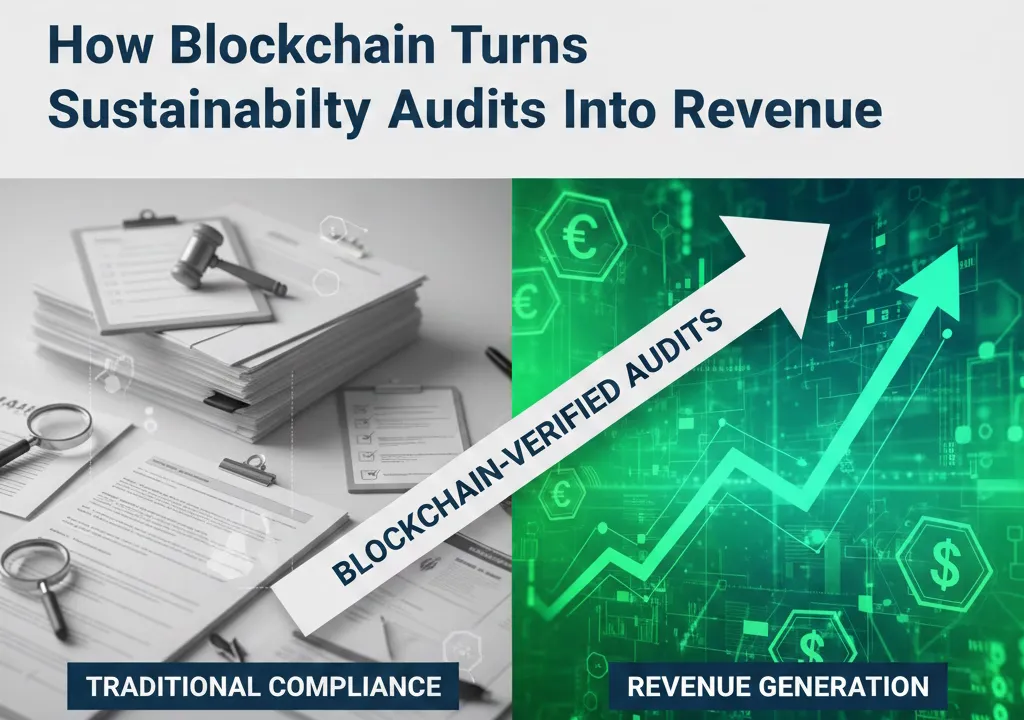
Sustainability audits were never designed to generate revenue. They were created to satisfy regulators, reassure stakeholders, and tick compliance checkboxes.
But the market has changed.
Today, sustainability performance directly influences carbon credit value, ESG financing access, procurement eligibility, and brand trust. In this new landscape, audits are no longer passive documents—they are economic signals. And blockchain is the technology that converts those signals into marketable assets.
For businesses investing in carbon reduction projects, renewable infrastructure, or ESG programs, blockchain-enhanced sustainability audits represent a strategic opportunity: turning verified impact into tradable value.
This article explores how blockchain transforms sustainability audits from static reports into revenue-generating infrastructure, and why companies that act early gain a measurable financial advantage.
The Hidden Problem with Traditional Sustainability Audits
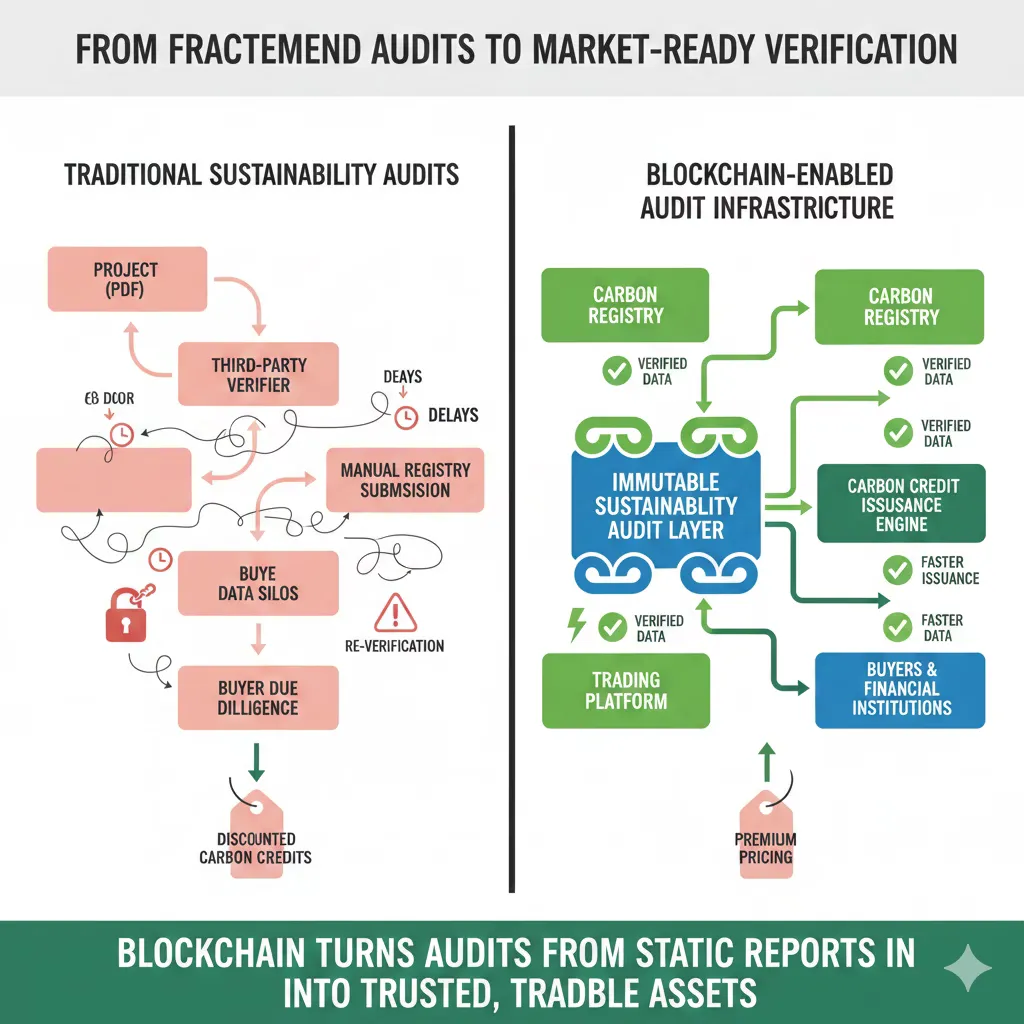
Despite their importance, most sustainability audits still operate on outdated assumptions:
- Audit data is stored in isolated databases or PDFs
- Verification is periodic, not continuous
- Traceability relies on trust rather than proof
- Reuse of audit data across markets is limited
These limitations create friction when audits are used beyond compliance—especially in carbon markets, where every claim must withstand scrutiny from registries, buyers, and regulators.
The result?
- Delayed carbon credit issuance
- Discounted credit pricing
- Higher verification costs
- Reduced buyer confidence
In short, traditional audits destroy value the moment they should be creating it.
Blockchain Changes the Role of Sustainability Audits
Blockchain doesn’t just “secure” audit data. It redefines what an audit is.
When sustainability data is recorded on a blockchain:
- Every data point is time-stamped
- Every modification is traceable
- Every verification is provable
- Every audit trail is immutable
This creates a single source of truth that can be trusted by:
- Carbon registries
- ESG rating agencies
- Institutional buyers
- Financial institutions
- Regulators across jurisdictions
The audit stops being a snapshot in time and becomes a living, verifiable asset.
From Compliance Artifact to Market Infrastructure
The most important shift blockchain enables is this:
Audits move from “proof of compliance” to “proof of value.”
Blockchain-backed sustainability audits can be directly integrated into:
- Carbon credit issuance workflows
- Credit lifecycle management systems
- Trading platforms and marketplaces
- ESG-linked financing tools
This integration removes friction between audit completion and monetization.
1. Earning Opportunity : Faster and More Valuable Carbon Credit Issuance
Carbon markets reward credibility, traceability, and speed.
Blockchain-enabled audits help businesses:
- Establish tamper-proof emission baselines
- Prove additionality with historical transparency
- Maintain continuous monitoring instead of annual checks
This leads to:
- Faster registry approvals
- Fewer audit rejections
- Lower verification disputes
- Stronger buyer confidence
Projects backed by blockchain-verifiable audits often command premium pricing, because buyers face less reputational and regulatory risk.
For project developers, this directly improves credit yield per ton.
2. Earning Opportunity: Premium Positioning in Voluntary Carbon Markets
Voluntary carbon markets are evolving rapidly. Buyers no longer accept generic offsets—they demand:
- Full audit transparency
- Clear project lineage
- Immutable verification trails
Blockchain-enhanced audits enable:
- End-to-end provenance tracking
- Public or permissioned audit access
- Real-time verification snapshots
This allows businesses to:
- Differentiate credits in crowded marketplaces
- Attract institutional and long-term buyers
- Secure forward contracts and offtake agreements
In a market increasingly plagued by trust issues, verified transparency becomes a pricing lever.
3. Earning Opportunity: ESG-Linked Financing and Capital Access
Financial institutions are tying lending terms to sustainability performance—but only when that performance is provable.
Blockchain-based sustainability audits:
- Reduce ESG due diligence costs
- Increase confidence in reported metrics
- Enable continuous compliance monitoring
For businesses, this translates into:
- Lower cost of capital
- Faster green loan approvals
- Eligibility for sustainability-linked incentives
Audit data becomes a financial credential, not just a reporting obligation.
Why Generic Sustainability Tools Fail at Scale
Many organizations attempt to digitize audits using off-the-shelf tools. These systems often fail because they:
- Lack registry-level integration
- Cannot support asset issuance
- Store data in mutable systems
- Break under multi-geography compliance
Blockchain-based platforms, when custom-built, solve these issues by design:
- Registry-aligned data structures
- Immutable audit layers
- Automated compliance logic
- Credit lifecycle traceability
This is why leading organizations move toward custom carbon credit trading platforms, not generic dashboards.
The Strategic Advantage of Owning the Platform
The biggest opportunity is not just issuing carbon credits.
It’s controlling the infrastructure that produces them.
Businesses that invest in blockchain-enabled audit and trading platforms gain:
- Ownership of audit data
- Reduced dependence on intermediaries
- Ability to onboard partners and suppliers
- Control over pricing, access, and analytics
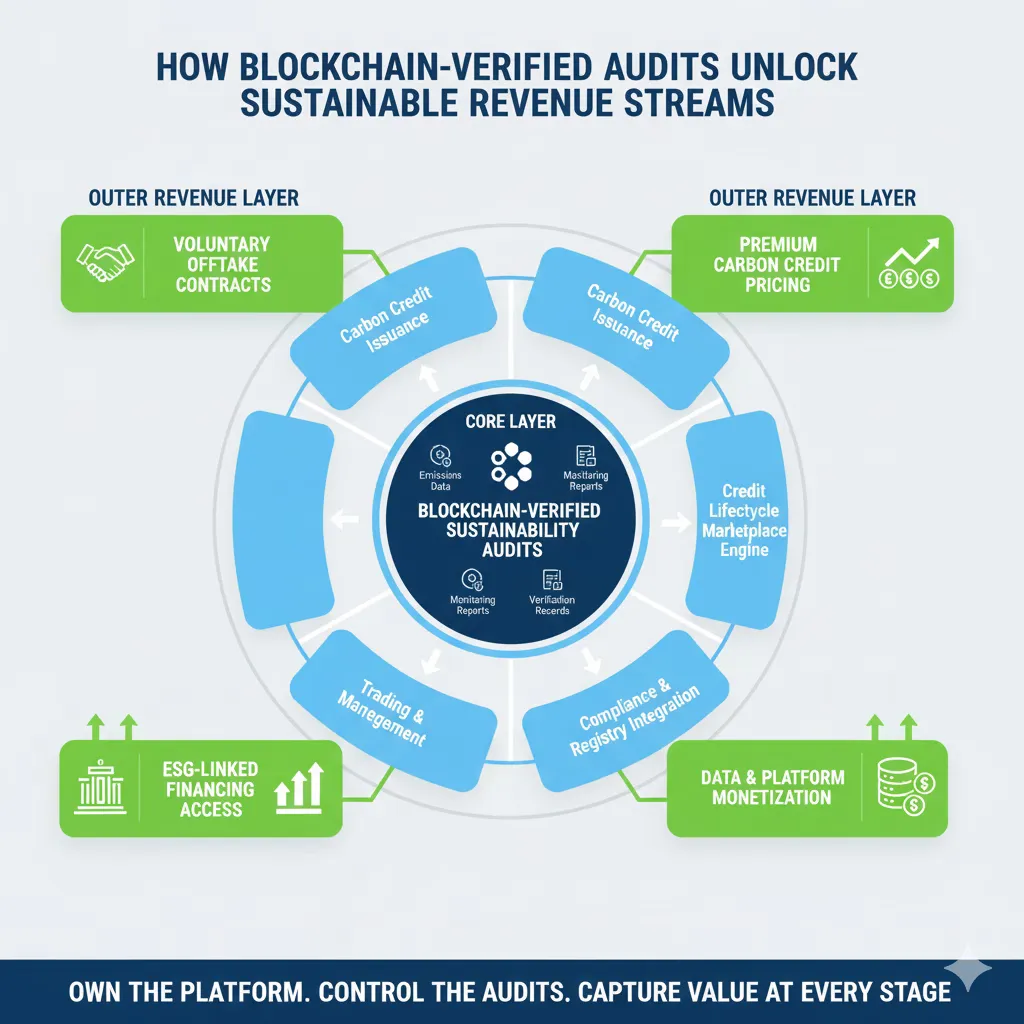
Over time, the platform itself becomes an asset—capable of generating revenue through:
- Transaction fees
- Data access services
- Ecosystem participation models
Real-World Scenario: Turning Sustainability Audits into Revenue Assets
Consider a renewable energy developer operating projects across multiple geographies.
Under Traditional Audit Models
Each project undergoes standalone verification, often with different auditors and timelines. Audit data is stored in disconnected systems and must be repeatedly revalidated for every buyer, registry, or financing partner.
As a result:
-
Verification cycles are slow and costly
-
Carbon credit issuance is delayed
-
Buyers apply risk-based discounts due to limited transparency
-
Price realization per credit is inconsistent
Despite genuine environmental impact, much of the value is lost to process friction and trust gaps.
With Blockchain-Enabled Audits and Trading Infrastructure
Audit data is recorded immutably and integrated directly into a carbon credit trading platform. Emissions baselines, monitoring data, and verification records remain continuously accessible and tamper-proof.
This enables:
-
Faster credit issuance aligned with registry requirements
-
Instant buyer access to verifiable audit trails
-
Reduced due diligence effort for counterparties
-
Greater buyer confidence and willingness to pay premium prices
Business Outcome
The same sustainability effort now delivers higher and more predictable returns, improved market access, and stronger long-term buyer relationships—without increasing operational complexity.
Blockchain doesn’t change the project. It changes how efficiently value is unlocked from it.
Why Platform Development Matters More Than Technology Choice
Blockchain alone doesn’t create value.
Value comes from how it’s implemented:
- How audit data flows into credit issuance
- How compliance rules are encoded
- How buyers verify authenticity
- How registries are integrated
This is why carbon credit trading platform development requires:
- Deep carbon market expertise
- Regulatory awareness
- Blockchain architecture design
- End-to-end lifecycle understanding
Without this, even the best technology fails to monetize impact.
The Business Case Is Clear
Sustainability audits are no longer a regulatory afterthought.
When powered by blockchain, they become:
- Revenue accelerators
- Trust engines
- Market enablers
- Financial credentials
Companies that recognize this shift early gain:
- Better pricing
- Faster market access
- Stronger investor confidence
- Long-term platform advantages
Final Thoughts: The Future Belongs to Audit-Driven Markets
The future of sustainability is not about reporting more data. It’s about proving impact in ways the market can trust—and pay for.
Blockchain-enhanced sustainability audits make this shift possible by turning verification into value, compliance into confidence, and environmental performance into a measurable economic asset.
For businesses serious about carbon markets, ESG leadership, and long-term value creation, the question is no longer whether to adopt blockchain. It’s how strategically to design and implement systems that convert verified impact into sustainable revenue.
This is where platform thinking matters—integrating audits, compliance logic, carbon credit issuance, and trading into a single, scalable infrastructure.
If you’re exploring how to transform sustainability audits into monetizable carbon assets, Techaroha helps enterprises design, build, and implement blockchain-enabled carbon credit trading platforms tailored to real market requirements.
👉 Start the conversation here: Contact Techaroha
Written by
Rasika Deshpande
Techaroha Solutions