Chatbot Interface
 Pay by Face
 Automated Blog Writer
 Annual Report Analysis
 Action Bot
 Private LLM for Lawyers
 Custom EVM
 Token & ICO Launch
 Bitcoin/Litecoin-Based
 Blockchain Raffle/Lottery
 Carbon Credit Management
 Stablecoin Development
 Metaverse with Native Token
 Crypto Payment Gateway
 Crypto Exchange Development
 WordPress Website Development
 Carbon Credit Exchange Platform
 Custom Mobile App Development
 Carbon Credit Registry
 Custom Website Development
 Case Studies
 Testimonials
 About Us
 Vision & Mission
 Insight Success
 Team
 Careers
Carbon Credit Marketplace Revenue Model: How Infrastructure Owners Build $10M+ Platforms
Proven carbon credit marketplace revenue models- fees, subscriptions & more. Learn how platform owners maximize ROI in a booming market.

The carbon credit market is no longer experimental.
Compliance markets were valued at $113.1 billion in 2024 and are projected to reach $458 billion by 2034, according to global climate finance projections from institutions such as the World Bank and market analysts at BloombergNEF.
But here’s the strategic question most enterprises miss:
Are you participating in the carbon market — or owning the infrastructure it runs on?
Because the real money isn’t in buying or selling credits. It’s in owning the platform where they trade.
If you are considering building a carbon credit trading platform, this is not a sustainability play.
It’s a financial infrastructure play.
Why Platform Owners Always Win
Stock exchanges don’t speculate on stocks. They monetize access, execution, listings, and data.
Carbon marketplaces operate the same way.
Every event on your platform becomes billable:
- A trade execution
- A credit issuance
- A project listing
- A verification workflow
- A compliance report generation
- A data API call
The strongest carbon credit marketplace revenue model is not a single stream. It is a layered revenue architecture.
The 6-Layer Carbon Marketplace Revenue Stack
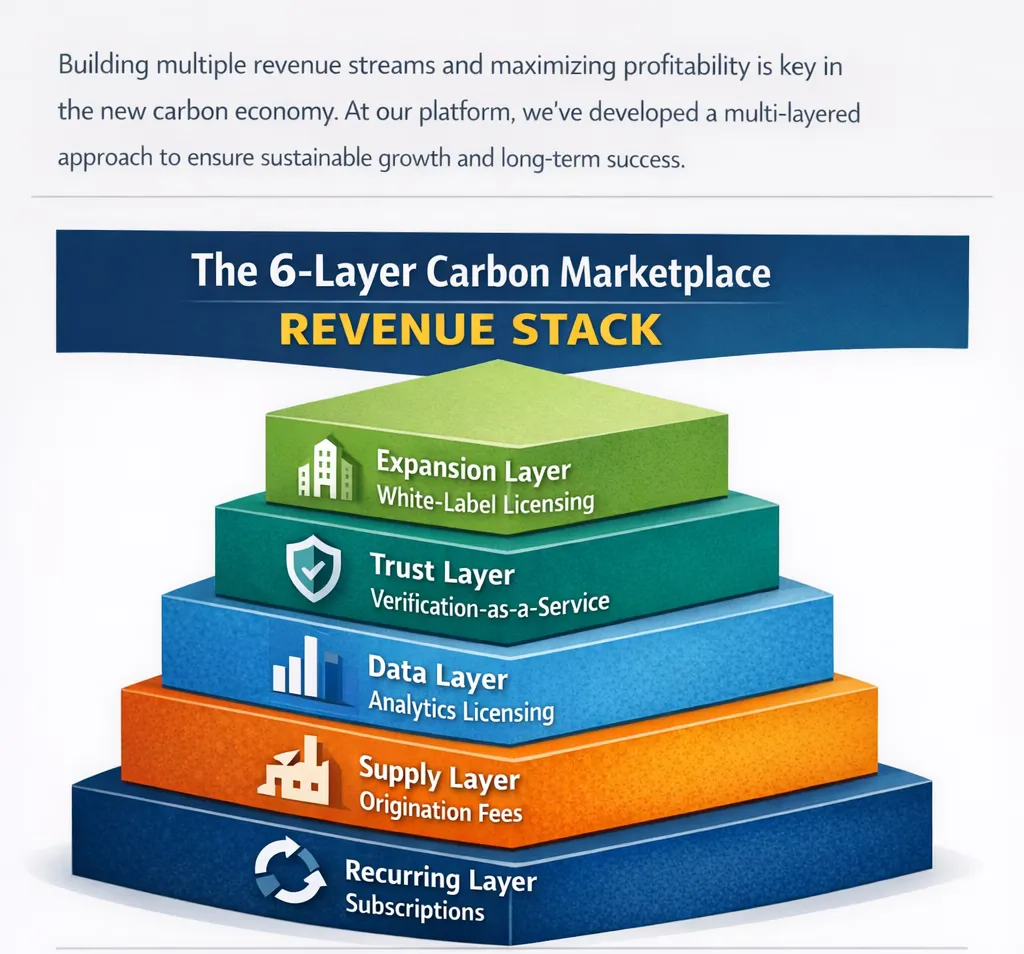
High-performing platforms activate all six.
1. Foundation Layer – Transaction Fees
2–5% per trade is industry standard.
Example: 500,000 tonnes annually at $40/tonne 3% fee = $600,000/year
At 2M tonnes, that becomes $2.4M/year.
Transaction fees scale automatically with liquidity.
2. Recurring Layer – Enterprise Subscriptions
Turn your marketplace into SaaS.
Typical structure:
- Starter: $299–$499/month
- Professional: $999–$1,999/month
- Enterprise: $4,000+/month
Even 50 enterprise subscribers generate $2.4M/year in recurring revenue — independent of trade activity.
This stabilizes cash flow and increases valuation multiples.
3. Supply Layer – Project Origination & Listing Fees
Most platforms monetize buyers. Smart platforms monetize both sides.
Charge:
- $500–$5,000 listing fee
- 1–3% success fee on project credit sales
Each project becomes a multi-year revenue source over a 10–25 year lifecycle.
4. Data Layer – Analytics & Intelligence Licensing
Every trade generates proprietary data:
- Price trends
- Demand by sector
- Geographic patterns
- Credit-type premiums
Package it as:
- Market intelligence reports
- API access
- Institutional research
Data licensing is typically the highest-margin stream.
You build once. You monetize repeatedly.
5. Trust Layer – Verification-as-a-Service
Premium verified credits trade significantly higher.
If your platform integrates workflows aligned with standards like:
- Verra
- Gold Standard
You can charge processing fees for streamlined verification.
Trust increases price per tonne. Higher price per tonne increases your transaction revenue.
6. Expansion Layer – White-Label Licensing
Banks, sustainability consultancies, and energy companies may want branded exchanges without building from scratch.
White-label licensing typically includes:
- $50,000–$200,000 upfront
- $5,000–$20,000/month maintenance
- Revenue share on trades
This expands your footprint without proportional sales expansion.
What Real ROI Looks Like (Year 3 Scenario)
Conservative mid-sized marketplace:
- 50 enterprise subscribers @ $4,000/month → $2.4M
- 300 professional subscribers @ $1,500/month → $5.4M
- 2M tonnes traded @ $40, 3% fee → $2.4M
- Data licensing (30 clients) → $720K
- 100 active projects → $500K
Total: $11.4M+ annually
From infrastructure built once.
This is why revenue architecture matters before development begins.
🇮🇳 India’s Carbon Market: A Strategic Timing Window
India is rapidly formalizing its compliance ecosystem through the Carbon Credit Trading Scheme (CCTS) under the guidance of the Ministry of Power and operational oversight by the Bureau of Energy Efficiency.
This signals structural demand for:
- Registry-integrated trading systems
- Compliance-grade reporting
- Automated emissions tracking
- Enterprise-ready infrastructure
India is in an early infrastructure build phase.
That creates a first-mover advantage for enterprises that launch compliant carbon trading platforms now — before regulatory maturity locks in dominant players.
Build Decision: Custom vs. Off-the-Shelf
Off-the-shelf solutions:
- Lock you into someone else’s fee structure
- Limit monetization layers
- Cap your revenue ceiling
- Prevent white-label scaling
Custom-built carbon exchange software:
- Gives you control over transaction fees
- Enables layered subscription models
- Allows proprietary data monetization
- Supports registry and compliance integration
- Unlocks white-label revenue
Development investment typically ranges from $150,000–$500,000 depending on complexity.
At enterprise subscription levels, that can be recovered within 12–18 months.
After that, infrastructure compounds.
The Strategic Shift: From Participant to Infrastructure Owner
When voluntary markets scale toward projected multi-billion-dollar levels this decade, the largest beneficiaries will not be occasional traders.
They will be the infrastructure owners.
The enterprises that:
- Design layered carbon credit marketplace revenue models
- Integrate compliance from day one
- Control their monetization stack
- Scale across voluntary and compliance markets
Those are the platforms that build durable, defensible, high-margin revenue engines.
If You’re Evaluating a Carbon Credit Trading Platform
The key question is not:
“Can we enter the carbon market?”
The real question is:
“How do we design a platform that monetizes every layer of the ecosystem?”
We work with enterprises, sustainability leaders, financial institutions, and climate-tech founders to:
- Architect multi-layer revenue models
- Design compliance-ready marketplace infrastructure
- Integrate verification and registry workflows
- Build scalable carbon exchange software
- Enable white-label and cross-border expansion
If you’re serious about building infrastructure instead of renting space on someone else’s, the architecture decisions you make today determine whether you build a $2M tool — or a $20M platform.
Contact Techaroha to build robust platform for the Carbon Credit Trading Platform
Written by
Rasika Deshpande
Techaroha Solutions