Chatbot Interface
 Pay by Face
 Automated Blog Writer
 Annual Report Analysis
 Action Bot
 Private LLM for Lawyers
 Custom EVM
 Token & ICO Launch
 Bitcoin/Litecoin-Based
 Blockchain Raffle/Lottery
 Carbon Credit Management
 Stablecoin Development
 Metaverse with Native Token
 Crypto Payment Gateway
 Crypto Exchange Development
 WordPress Website Development
 Carbon Credit Exchange Platform
 Custom Mobile App Development
 Carbon Credit Registry
 Custom Website Development
 Case Studies
 Testimonials
 About Us
 Vision & Mission
 Insight Success
 Team
 Careers
When the Forest Burns After the Sale: Fixing Reversal Risk With Self-Healing Buffer Pool Ledgers
Carbon credit reversal risk software auto-replaces invalidated credits via self-healing buffer pools, shielding exchanges from legal exposure.
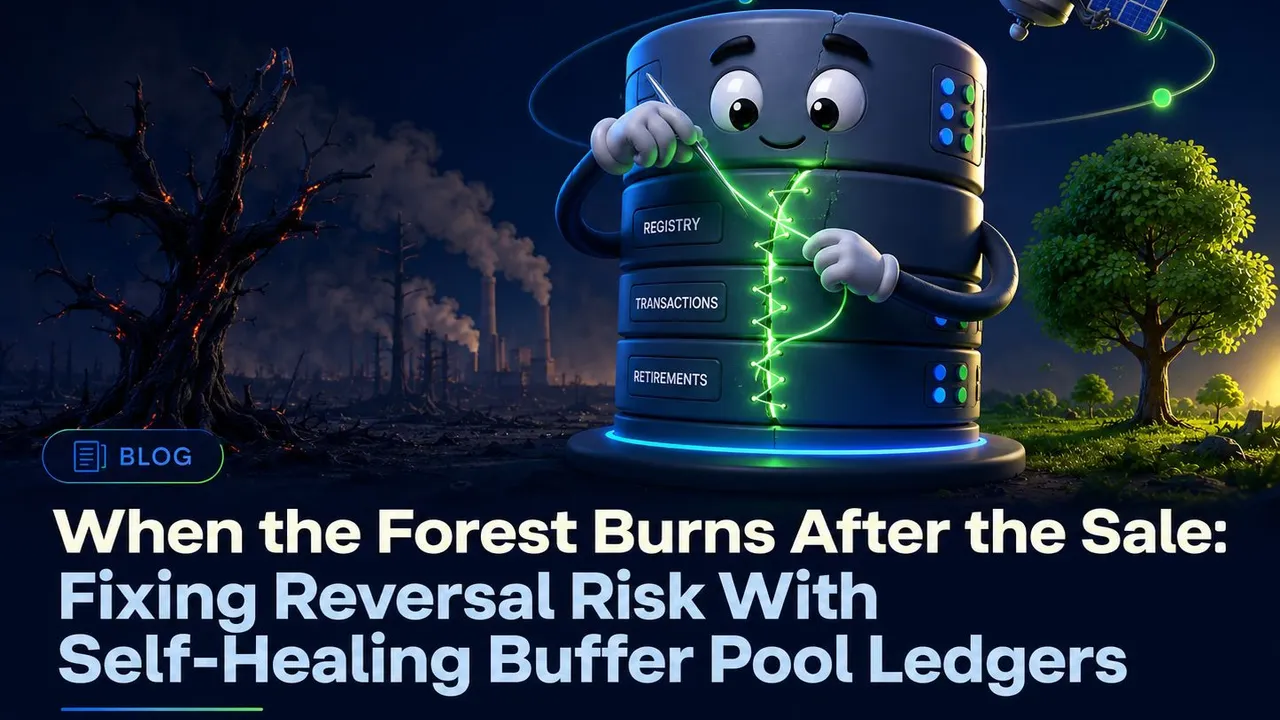
A project developer lists 500,000 nature-based forestry credits on an exchange. Six months later, a buyer resells 200,000 of them to a compliance desk in another country. Fourteen months after that, a wildfire tears through the project area and a satellite monitoring system flags the underlying carbon stock as gone. The credits are now scientifically invalid. They have also already changed hands twice.
This is the scenario every carbon exchange legal team quietly dreads, and it is exactly the problem that carbon credit reversal risk software is supposed to solve not by preventing wildfires, but by making sure a wildfire two states away never becomes a lawsuit on your platform. Most exchanges today have no carbon credit reversal risk software in place at all, which means they have no good answer to the question “who absorbs the liability when a resold credit turns out to be invalid?” This blog is for the people who have to answer that question before a regulator or a plaintiff’s attorney asks it for them: exchange founders, clearing house operators, and the insurance and legal teams underwriting carbon market risk.
Why Reversal Risk Is a Software Problem, Not Just a Registry Problem
Without dedicated carbon credit reversal risk software running underneath the exchange, none of the registry-level protections described below ever reach the individual buyer who actually holds the affected credit.
Registries like Verra, ACR, and Gold Standard have run buffer pools for years. A project contributes a percentage of its issued credits, typically 10 to 20%, into a shared reserve. If a reversal happens, the registry cancels an equivalent number of buffer credits to preserve the environmental integrity of the credits still in circulation. That part of the system works reasonably well at the registry layer.
The problem is what happens between the registry and the end buyer. A registry buffer pool protects the overall supply of credits in the market. It does nothing to protect a specific buyer who purchased a specific serial-numbered credit that later turns out to sit inside a reversed project. Without carbon credit reversal risk software built directly into the exchange’s own ledger, that buyer is left holding an asset the registry itself no longer recognizes as valid, and the exchange has no automated way to make them whole. This is precisely the gap that purpose-built carbon credit reversal risk software is designed to close.
This is the gap most trading platforms were never built to close:
- Registry buffer pools operate at the project level. They replace value in aggregate, not a specific transaction on your platform.
- Secondary market trades happen faster than registry corrections. A credit can be resold three or four times before a reversal is even confirmed.
- Manual remediation doesn’t scale. Legal teams issuing case-by-case refunds or replacement credits cannot keep pace with institutional trading volumes.
- Freezing trading kills liquidity. The instinctive response of halting the market the moment a reversal is suspected punishes every buyer holding unrelated, perfectly valid credits.
What Carbon Credit Reversal Risk Software Actually Has to Do
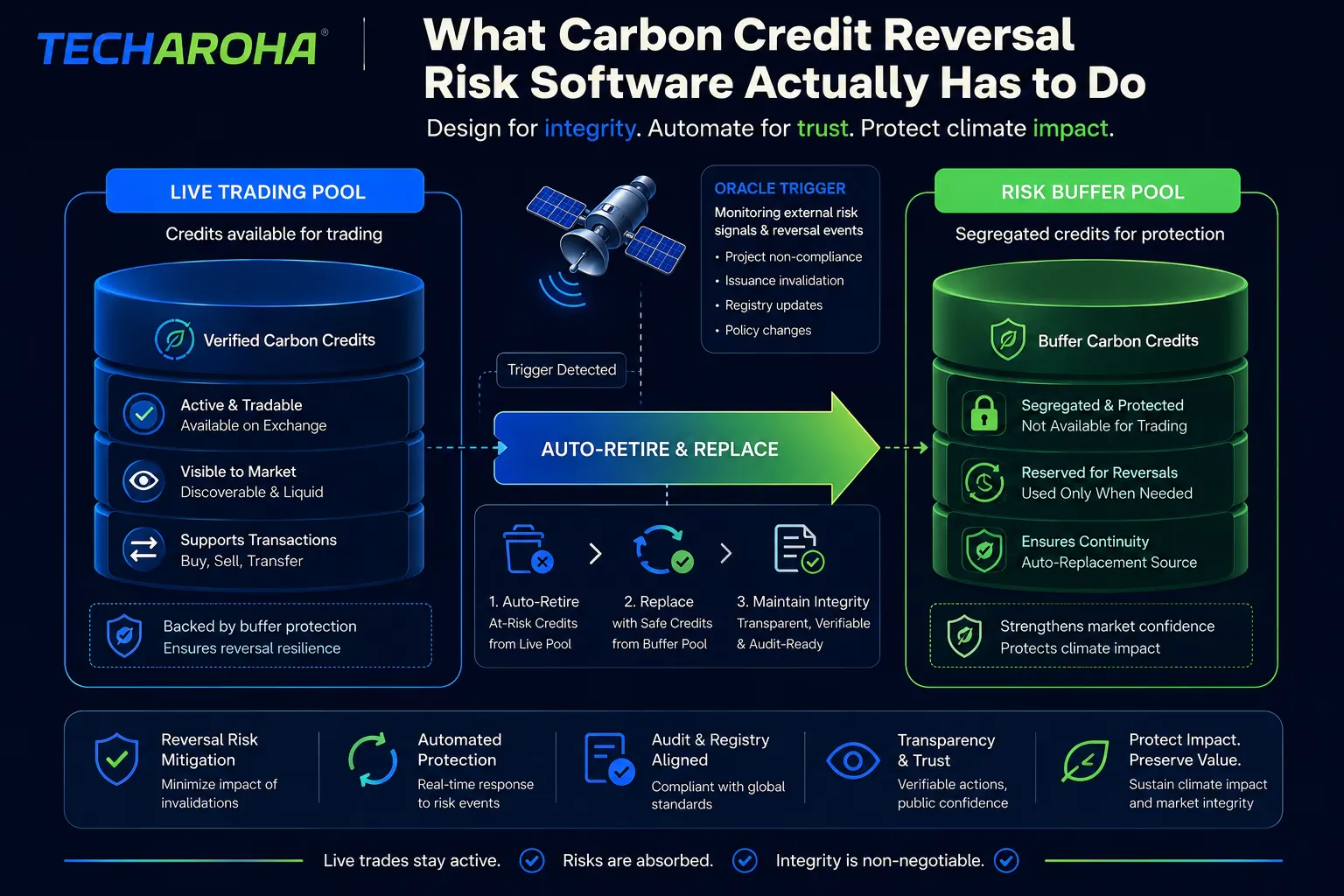
Good carbon credit reversal risk software doesn’t try to predict wildfires or droughts. It treats reversal as a known, statistically inevitable event and builds the exchange’s own ledger to absorb it automatically, the same way a payments network reserves against chargebacks instead of pretending fraud won’t happen. Purpose-built carbon credit reversal risk software succeeds or fails on exactly this design choice.
That means the platform needs three things working together, all of which any credible carbon credit reversal risk software has to deliver in concert:
- A dynamic, exchange-level Risk Buffer Pool that sits inside the platform’s own ledger, separate from and in addition to any registry-level buffer.
- An oracle layer that ingests satellite and remote-sensing reversal signals and translates them into a ledger event, not a support ticket.
- A clearing routine that retires buffer credits and re-issues replacement value automatically, without freezing any part of the order book that isn’t directly affected.
Architecting the Self-Healing Buffer Engine
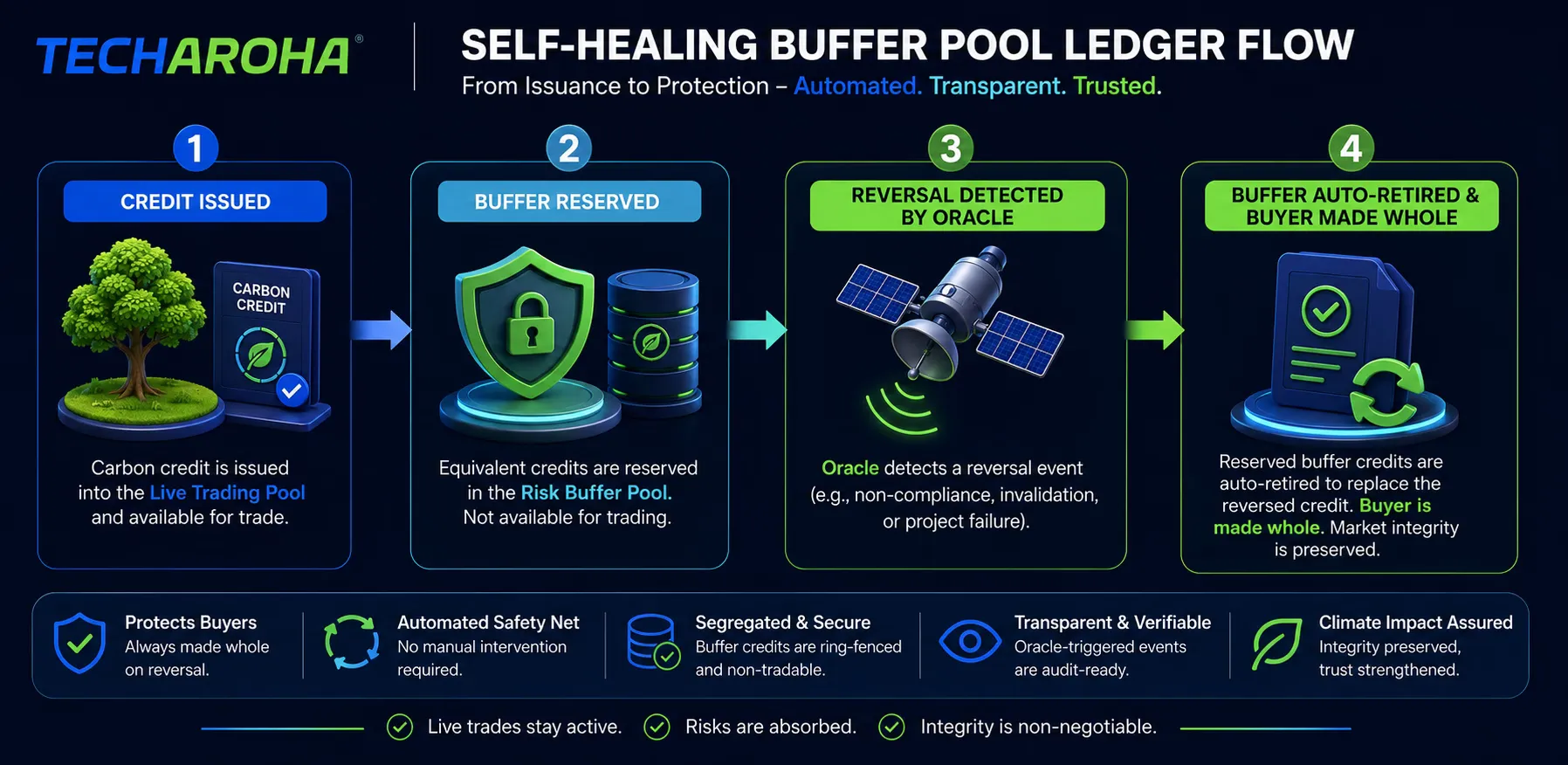
Building working carbon credit reversal risk software comes down to three engineering stages: reserve allocation, oracle verification, and programmatic clearing.
Step 1: Dynamic Reserve Allocation at Issuance
Every time a batch of nature-based credits is minted onto the exchange, the ledger automatically routes a configurable percentage commonly 10–15%, adjustable by project risk category into a segregated Risk Buffer Pool smart contract or database partition. This isn’t a manual finance-team task. It happens at the moment of issuance, as part of the minting transaction itself, so no credit ever enters secondary trading without its buffer contribution already reserved.
The reserve percentage shouldn’t be static across every project type. A well-designed system weights it by:
| Risk Factor | Lower Buffer Allocation | Higher Buffer Allocation |
|---|---|---|
| Project type | Enhanced rock weathering, engineered removals | Deferred timber harvest, REDD+ forestry |
| Geography | Low wildfire/flood exposure regions | High-disturbance climate zones |
| Monitoring quality | High-frequency satellite + ground sensor coverage | Sparse or infrequent verification |
| Project maturity | Long track record, no prior reversals | New project, unproven permanence |
Step 2: The Verification Oracle Inside the Carbon Credit Reversal Risk Software Stack
A satellite monitoring feed or a registry’s own reversal notification API pushes a structured event into the platform: project ID, estimated tonnage lost, confidence score, timestamp. This is the same architectural pattern used for CORSIA settlement verification: the oracle sits between an external data source and the exchange’s clearing logic, translating an outside signal into something the ledger can act on deterministically rather than something a compliance officer has to interpret by eye.
Step 3: Programmatic Clearing, Not Manual Triage
This is the step where carbon credit reversal risk software either proves its value or falls back into the manual triage it was supposed to replace.
Once the oracle confirms a reversal above a set confidence threshold, the clearing system executes a scoped transaction:
- It identifies exactly which serial-numbered credits from the affected project are currently held by secondary buyers.
- It retires an equivalent tonnage from the Risk Buffer Pool.
- It re-issues or re-tags the affected buyer’s holdings against the buffer-sourced replacement credits.
- It logs the entire sequence - invalidation, retirement, replacement as an immutable, timestamped ledger event that any auditor, insurer, or regulator can independently verify.
None of this touches unrelated trades. A reversal in one forestry project in one region does not freeze the order book for every other credit type on the exchange. That distinction, scoped, automatic remediation instead of platform-wide panic — is the entire commercial value of the architecture.
Why This Isn’t Just a Nice-to-Have: The Liability Question, Answered
This is where carbon credit reversal risk software earns its place as core infrastructure rather than an optional add-on.
Here’s the uncomfortable reality legal teams already know: absent a self-healing mechanism, the liability question in a reversal event has no clean answer. Did the exchange perform adequate due diligence on the credit it listed? Did the reselling buyer misrepresent the credit’s status? Is the original project developer liable for a natural disaster outside their control? These questions can take years and significant legal spend to resolve, and every year they stay unresolved is a year institutional buyers hesitate to trade in volume.
Well-built carbon credit reversal risk software, running as a self-healing buffer pool ledger, doesn’t eliminate the underlying scientific risk of reversal. It removes the exchange from the liability chain by design: the buyer’s economic position is automatically restored from a pre-funded reserve, the transaction record shows exactly when and how remediation happened, and no party has to litigate who owes whom.
The comparison is straightforward:
| Dimension | Exchange Without Self-Healing Buffer Logic | Exchange With Self-Healing Buffer Pool Ledger |
|---|---|---|
| Reversal remediation | Manual, case-by-case, legal-team-driven | Automatic, ledger-triggered, scoped to affected credits |
| Time to buyer resolution | Weeks to months | Minutes to hours |
| Impact on unrelated trading | Often frozen platform-wide during investigation | Zero - only affected holdings are touched |
| Audit trail | Assembled after the fact, inconsistently | Immutable, timestamped, generated automatically |
| Institutional buyer confidence | Erodes with every unresolved incident | Reinforced by demonstrable, fast remediation |
| Insurance underwriting | Difficult to price without clear process | Priceable - insurers can model a defined mechanism |
Read: The Post-Transition Purge: Why Every Carbon Exchange Needs a Carbon Credit Invalidation Protocol Now
Who Carbon Credit Reversal Risk Software Matters Most To
- Exchange founders and CTOs evaluating whether their platform architecture can survive a reversal event without a legal crisis, not just a technical one.
- Clearing house operators who need a defensible, automated settlement process they can point to when a counterparty disputes a retired credit.
- Insurance and reinsurance firms underwriting carbon market risk, who need a modelable, rules-based remediation process rather than an open-ended liability question.
- Compliance officers and ESG directors at buy-side institutions who need proof that the exchange they’re trading on runs real carbon credit reversal risk software, not a policy document that’s never been tested.
Building This Right: What a Custom Carbon Credit Reversal Risk Software Implementation Requires
Custom carbon credit reversal risk software is not a plugin you bolt onto an existing matching engine. It has to be designed as its own service layer, one that can reserve credits at issuance, ingest external reversal signals, and execute scoped clearing transactions without ever touching the parts of the order book that aren’t affected. That’s a materially different engineering challenge than a standard token-issuance workflow, and it’s the kind of architecture that determines whether an exchange can credibly claim enterprise-grade risk resilience to institutional counterparties and insurers.
Reversal risk isn’t going away as nature-based credit volumes grow. The exchanges that win institutional trust over the next few years will be the ones running real carbon credit reversal risk software, not the ones still writing legal memos after every wildfire season.
If you’re evaluating whether your platform’s architecture can actually survive a reversal event legally and technically, building carbon credit reversal risk software from the ground up is exactly the kind of custom infrastructure work we do.
Book a call with our engineering team!
to walk through what a self-healing buffer pool ledger would look like for your exchange.
Written by
Rasika Deshpande
Techaroha Solutions