Chatbot Interface
 Pay by Face
 Automated Blog Writer
 Annual Report Analysis
 Action Bot
 Private LLM for Lawyers
 Custom EVM
 Token & ICO Launch
 Bitcoin/Litecoin-Based
 Blockchain Raffle/Lottery
 Carbon Credit Management
 Stablecoin Development
 Metaverse with Native Token
 Crypto Payment Gateway
 Crypto Exchange Development
 WordPress Website Development
 Carbon Credit Exchange Platform
 Custom Mobile App Development
 Carbon Credit Registry
 Custom Website Development
 Case Studies
 Testimonials
 About Us
 Vision & Mission
 Insight Success
 Team
 Careers
CORSIA Settlement Lag: The Real Cost for Carbon Desks Now
CORSIA settlement lag exposes airlines to volatility counterparty risk. See how automated CA verification oracles close the gap in real time.
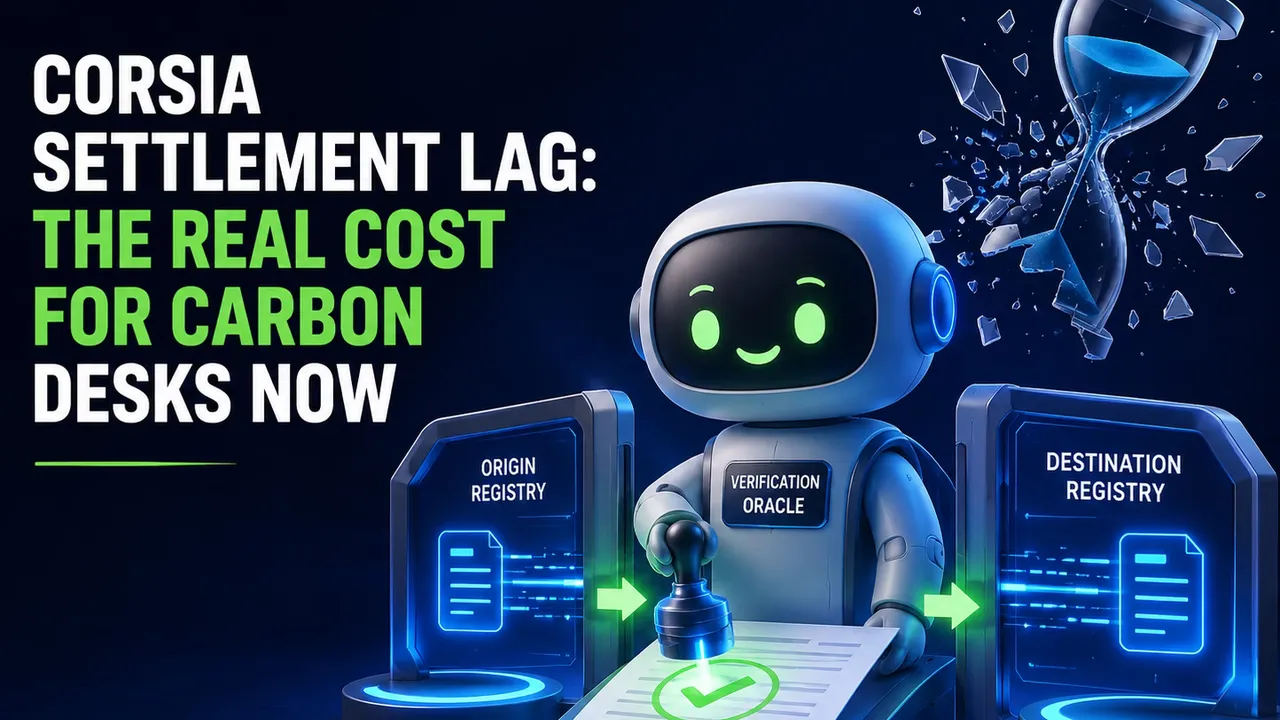
CORSIA Phase I closes out its compliance window between 2024 and 2026, and something quietly expensive has been happening on every desk trading Article 6-eligible inventory: CORSIA settlement lag. Not price risk. Not supply risk, although that exists too. A slower, more mechanical problem: the gap between when a trade is agreed and when it actually clears, and it is costing airlines, brokers, and exchanges real money every single week.
This post is for the people who feel that gap directly: exchange founders building compliance-grade trading infrastructure, CTOs responsible for uptime and settlement integrity, and ESG or carbon fund managers who need certainty that the credit they bought this morning will still be theirs, cleanly, by end of day.
Why CORSIA Settlement Lag Exists in the First Place
CORSIA-eligible credits carry a specific compliance signature: a host-country Letter of Authorization (LoA) confirming that a Corresponding Adjustment (CA) has been or will be applied under Article 6 of the Paris Agreement. That signature is what separates a credit airlines can legally retire against their CORSIA obligation from a credit that looks identical on paper but carries none of that protection.
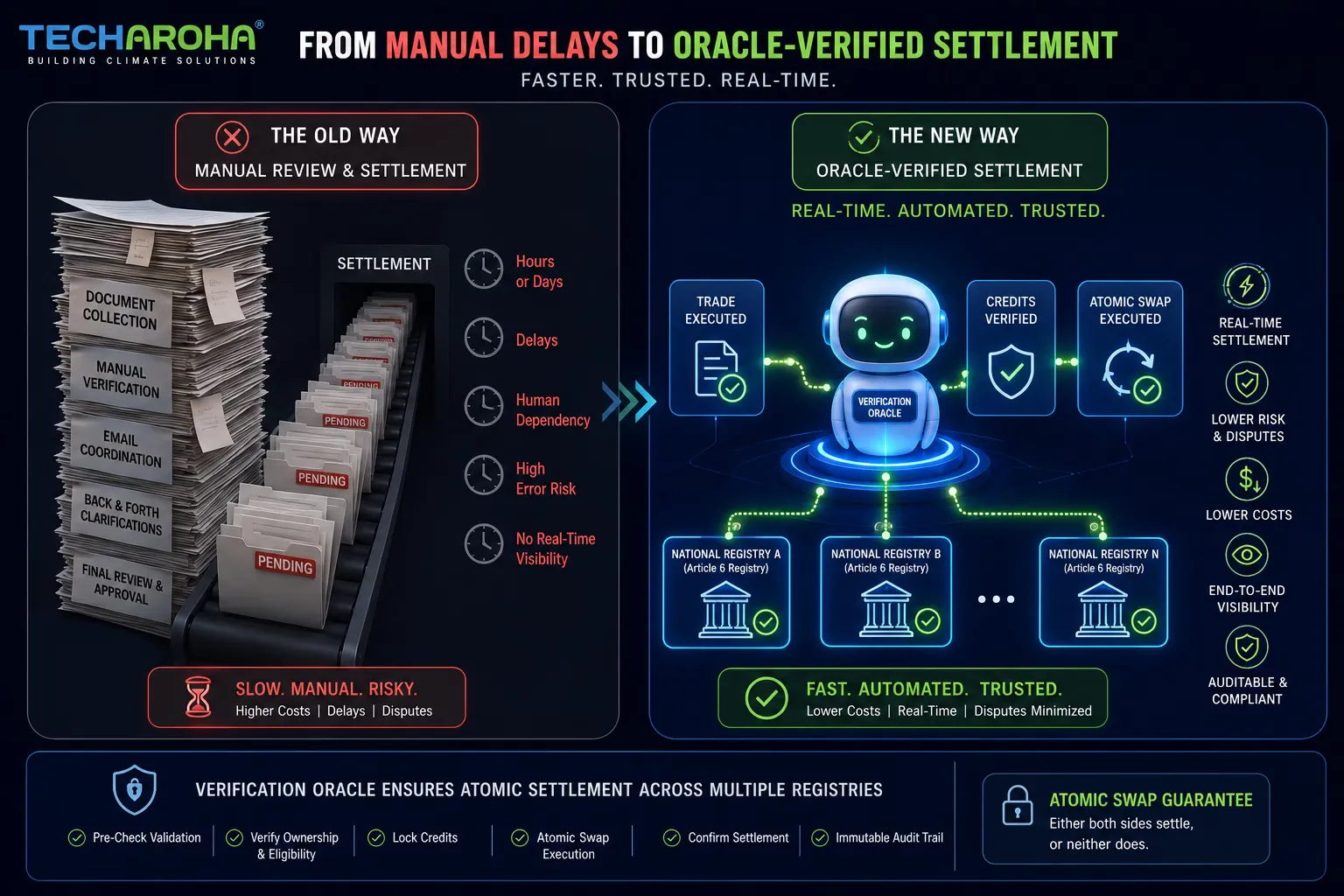
The problem is where that verification actually happens. On most platforms today, it happens manually, after the trade is agreed, not before. A compliance officer or broker pulls a PDF, checks a registry reference number by eye, maybe emails a national registry contact to confirm a host-country attestation, and only then releases funds or clears the trade. During CORSIA’s most active trading hours, that manual review queue backs up. What should be a same-day settlement becomes a multi-day wait, and that wait is CORSIA settlement lag in its purest form.
In numbers, the shape of the problem looks like this:
| Factor | Manual Verification Reality |
|---|---|
| LoA/PDF cross-check time | Hours to multiple days per trade |
| National registry API response variance | Inconsistent across host countries, no unified standard |
| Peak-hour trade backlog | Queued behind other manual reviews |
| Double-selling exposure | High, since sovereign registries do not talk to each other in real time |
| Counterparty risk during lag window | Rises with every hour price moves against either side |
None of this is a compliance failure in the legal sense. Every credit involved may be perfectly legitimate. The failure is architectural: verification sits in a slow, disconnected, human-mediated layer instead of inside the settlement pipeline itself.
The Software Problem Nobody Is Pricing In
Here is the part that gets missed in most CORSIA commentary, which tends to stay at the policy level. CORSIA settlement lag is not a regulatory problem waiting on ICAO or a host government. It is a systems design problem, and it sits squarely inside the exchange’s own technology stack.
Three specific failure modes show up again and again on platforms that have not solved this:
- Failed trades from stale authorization data. A credit that looked CA-authorized at the time of order placement may have its status change before manual review finishes, especially with host countries still catching up on Article 6.4 backlog processing.
- Delayed clearing that erodes trust. Institutional buyers — banks, carbon funds, large airline treasury desks — measure counterparty reliability partly by settlement speed. A platform where trades sit unresolved for days looks fragile, regardless of how sound its underlying credit inventory is.
- Double-selling across disparate sovereign registries. Because national Article 6 registries do not share a common real-time interface, the same underlying authorization can, in theory, be referenced by more than one pending trade before either settles. Manual, batch-style verification has no way to catch this in time.
Each of these failure modes translates directly into either a lost trade, a compliance exception that has to be manually unwound, or a client who moves their volume to a competitor with faster clearing. CORSIA settlement lag is not an inconvenience. It is a line item.
Why Batch Verification Cannot Scale With CORSIA Phase I Demand
Most exchanges built their compliance-checking logic the same way they built everything else in the voluntary carbon market era: as an overnight batch job or a manual queue, because volumes were low enough that nobody needed anything faster. CORSIA changes that math completely.
Phase I demand for CORSIA-eligible emissions units runs into the hundreds of millions of tonnes, against a supply of authorized inventory that has consistently lagged behind. That imbalance means every unit with a confirmed corresponding adjustment carries a real premium, and premium assets attract fast-moving, high-frequency trading behavior — exactly the environment where batch-style verification breaks down first.
Reduce CORSIA settlement lag using batch logic, and the fix is temporary at best. Volume simply outgrows the review queue again within a quarter. This is the same category of design mistake carbon market infrastructure keeps repeating: putting compliance-critical logic in the slowest layer of the system instead of the fastest.
The Engineering Solution: An API Middleware and Verification Oracle
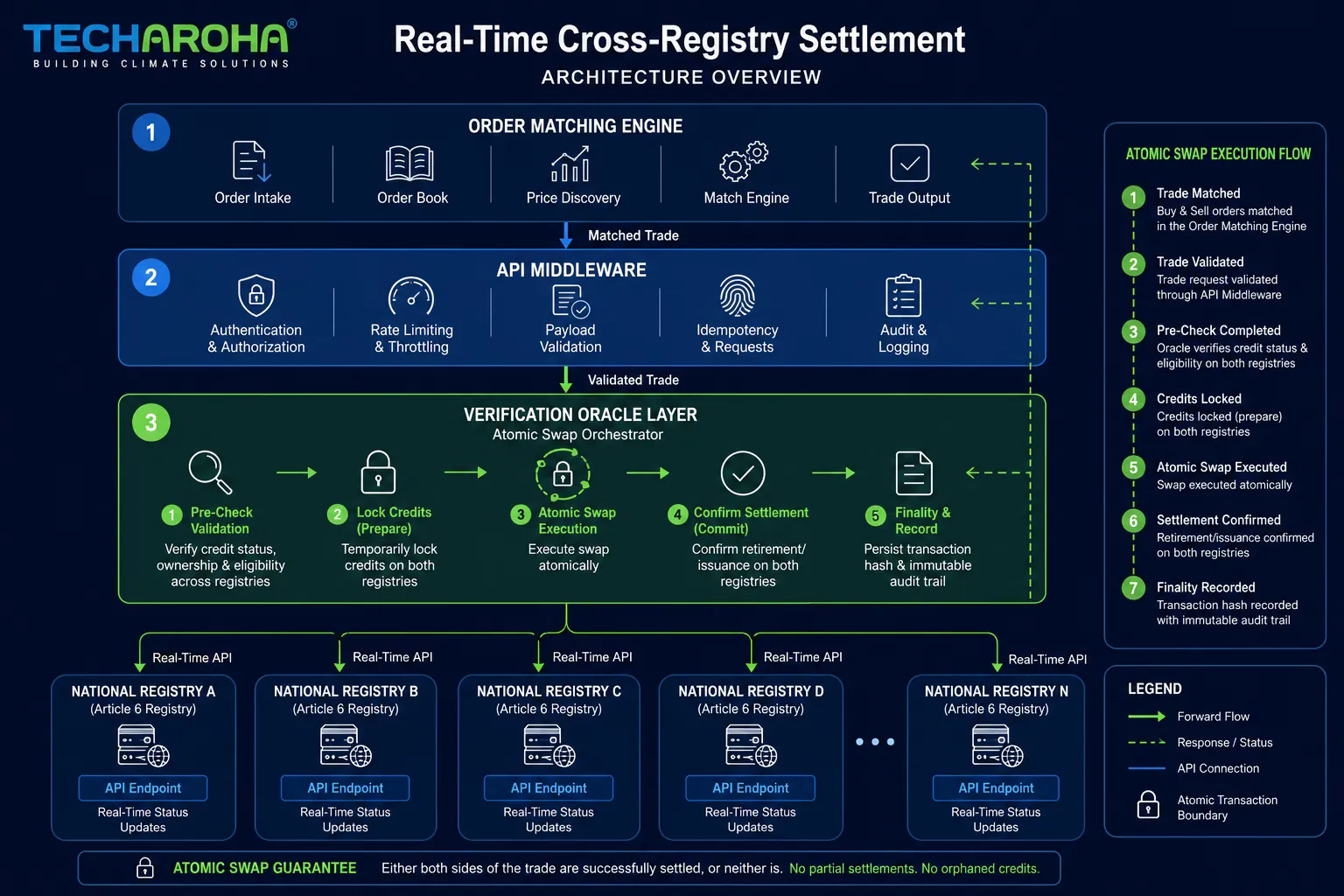
The fix is not more people reviewing PDFs faster. It is a structural change to where and when verification happens. The pattern that actually resolves CORSIA settlement lag is a dedicated API Middleware and Verification Oracle — a service layer that sits between the order matching engine and every national Article 6 registry endpoint a platform touches.
Here is how that architecture actually functions in practice:
- Order intake with pre-flight authorization check. The moment an order references a specific CORSIA-eligible unit, the middleware queries the relevant host-country registry API endpoint directly, not a cached snapshot, for the current corresponding adjustment status tied to that unit’s serial number.
- Cryptographic hash verification of the LoA. Rather than a human comparing PDF text, the oracle checks the host-country authorization against a cryptographic hash reference, confirming the document has not been altered and matches the exact unit being traded.
- Real-time status gate on the matching engine. The order matching engine only allows a match to proceed to execution once the oracle returns a positive verification. If the status is pending, ambiguous, or flagged, the order is held automatically, not manually escalated after the fact.
- Atomic swap execution. Once verification clears, fund release and unit transfer execute as a single atomic operation. Either both legs of the trade complete together, or neither does. This closes the exact window where double-selling and partial settlement failures used to occur.
- Instant fund release tied to verified state, not elapsed time. Buyers are no longer waiting on a compliance officer’s calendar. Settlement happens the moment the oracle confirms authorization, which for most registries with functioning API access can be seconds, not days.
- Continuous re-verification for pending inventory. For units still awaiting host-country CA confirmation, the oracle keeps polling registry status in the background, automatically clearing the unit for trading the moment authorization posts, instead of waiting for a manual recheck cycle.
This is the architectural difference between a platform that treats CORSIA settlement lag as an unavoidable cost of doing business, and one that treats it as a solved engineering problem.
What Changes for Airlines, Brokers, and Compliance Desks
The people reading this closely — airline compliance managers, carbon brokers, institutional trading desks — are the ones who feel CORSIA settlement lag as risk exposure, not abstraction. Here is what an automated CA verification oracle actually changes for each of them:
- Airline compliance managers get certainty at the moment of purchase, not days later. A unit that clears the oracle is retirable against CORSIA obligations with a verifiable audit trail attached, which matters enormously when ICAO or a national authority asks for evidence.
- Carbon brokers stop absorbing the price risk that sits inside a multi-day settlement window. Faster clearing means less exposure to the credit’s price moving against either side of the trade while verification drags on.
- Institutional trading desks gain the kind of predictable settlement behavior that regulated finance already expects from other asset classes. A platform that clears CORSIA-eligible inventory in near real time looks and behaves like serious market infrastructure, not a workaround built for a smaller, slower era of voluntary carbon trading.
A Comparison: Manual Review vs. Oracle-Verified Settlement
| Dimension | Manual PDF/Batch Review | API Middleware and Verification Oracle |
|---|---|---|
| Verification timing | After trade agreement | Before order matches |
| Time to clear | Hours to multiple days | Seconds to minutes |
| Double-selling protection | Weak, relies on human cross-checking | Structural, enforced at the settlement layer |
| Scalability under Phase I volume | Breaks down under peak load | Scales with registry API throughput |
| Audit trail | Manually assembled, inconsistent | Cryptographically verifiable, automatic |
| Institutional buyer confidence | Erodes with each delayed trade | Reinforced by consistent, fast clearing |
Why This Cannot Be Bolted on as a Front-End Feature
A recurring mistake in carbon market software is treating compliance verification as something that can live in the interface layer, a checkbox a trader could, in theory, bypass through a direct API integration or an internal override. CORSIA settlement lag will not actually go away if the oracle only checks orders placed through a website UI while institutional desks connecting through a raw API skip the check entirely.
The verification oracle has to be enforced at the settlement layer itself, where funds and units actually change hands, not wherever is fastest to build. That is an architectural decision, not a feature toggle, and it is the difference between a platform that has genuinely solved CORSIA settlement lag and one that has only hidden it from the average user.
Read- The Post-Transition Purge: Why Every Carbon Exchange Needs a Carbon Credit Invalidation Protocol Now
Advisory Framing: What Is Live Today vs. What This Describes
To be direct about scope: this post describes an architectural pattern for eliminating CORSIA settlement lag through real-time corresponding adjustment verification and atomic settlement. It reflects the kind of engineering approach a purpose-built carbon exchange needs to handle Article 6-eligible inventory at CORSIA Phase I volumes. Specific implementation details for any given platform, including exact API integrations with individual national registries, should be scoped and verified against that platform’s actual production environment before going live.
The Bigger Picture: Settlement Speed Is Becoming a Competitive Line Item
CORSIA Phase I is compressing timelines across the board. Host countries are still working through LoA backlogs. Authorized supply remains tight relative to demand. In that environment, the exchanges and platforms that solve CORSIA settlement lag structurally, not with more manual staff, are the ones that will hold onto institutional trading volume as Phase II approaches.
Airlines, brokers, and fund managers evaluating carbon trading infrastructure right now should be asking a direct question: does this platform verify corresponding adjustments before the trade clears, or after? That single answer determines whether CORSIA settlement lag is a manageable footnote or a recurring source of failed trades, price exposure, and audit risk.
If your team is scoping a custom carbon credit trading platform, or auditing whether your current settlement architecture can actually absorb CORSIA Phase I volume without CORSIA settlement lag eating into your margins, that is exactly the kind of build Techaroha specs and architects for clients working at this intersection of software engineering and carbon market compliance.
Written by
Rasika Deshpande
Techaroha Solutions