Chatbot Interface
 Pay by Face
 Automated Blog Writer
 Annual Report Analysis
 Action Bot
 Private LLM for Lawyers
 Custom EVM
 Token & ICO Launch
 Bitcoin/Litecoin-Based
 Blockchain Raffle/Lottery
 Carbon Credit Management
 Stablecoin Development
 Metaverse with Native Token
 Crypto Payment Gateway
 Crypto Exchange Development
 WordPress Website Development
 Carbon Credit Exchange Platform
 Custom Mobile App Development
 Carbon Credit Registry
 Custom Website Development
 Case Studies
 Testimonials
 About Us
 Vision & Mission
 Insight Success
 Team
 Careers
How Does Fractional Carbon Credit Tokenization Work?
Discover how fractional carbon credit tokenization unlocks liquidity, reduces entry barriers & delivers 300%+ ROI through blockchain platforms.
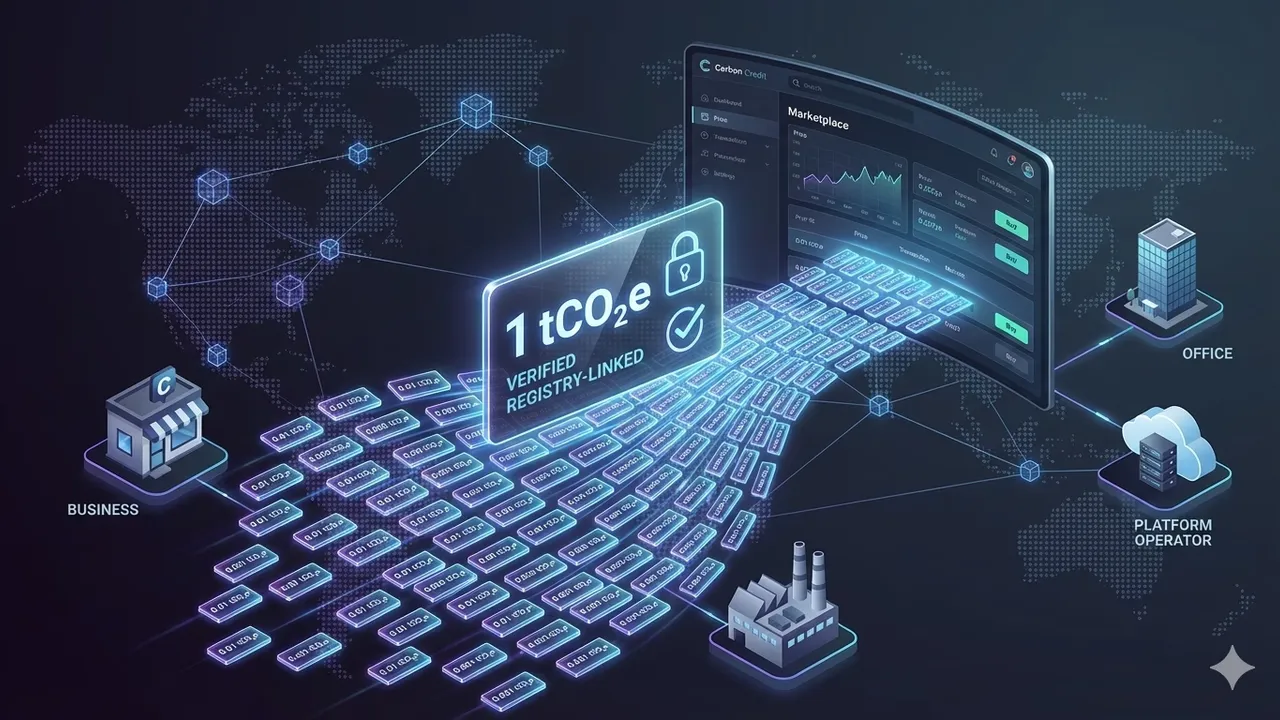
Unlocking carbon market access through blockchain-based fractional ownership
The global carbon credit market crossed $2 billion in 2024, yet nearly 73% of small and mid-sized businesses remain locked out. High minimum purchase requirements, rigid contract sizes, and manual trading processes make participation impractical for organizations with modest emissions footprints.
Fractional carbon credit tokenization changes this dynamic by transforming verified carbon credits into divisible digital assets that can be traded, owned, and retired in precise quantities. Instead of purchasing entire credits in bulk, organizations can access carbon markets with accuracy, flexibility, and lower capital commitments—while platform operators unlock new revenue at scale.
This is no longer experimental. Companies deploying tokenized carbon credit platforms are achieving 300%+ ROI within 18 months, expanding buyer access by over 400%, and dramatically improving credit utilization.
The $30,000 Entry Barrier: Why Traditional Carbon Markets Fail SMEs
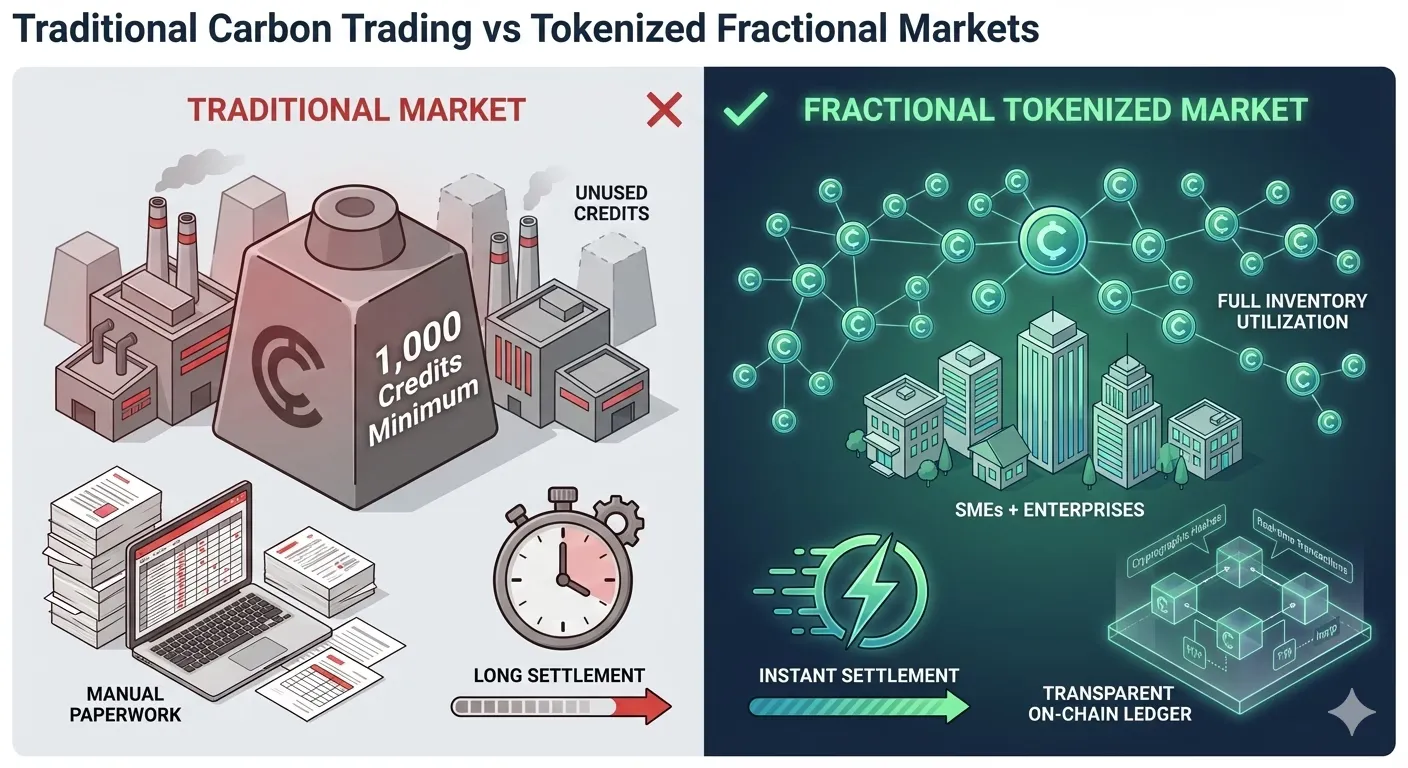
Conventional carbon markets were built for enterprise buyers. A typical transaction requires minimum purchases of 1,000 credits or more, translating to $30,000–$50,000 per deal.
For a regional logistics firm emitting 200 tons annually, this means buying five times more offsets than needed—or not participating at all.
According to 2024 market research:
- 68% of businesses under $10M in revenue want to offset emissions
- Most abandon the process due to:
- Excessive minimum order quantities
- Fixed verification costs
- Limited liquidity and resale options
This creates a systemic contradiction: organizations best positioned to adopt sustainability practices are excluded by infrastructure designed for large buyers only.
How Fractional Carbon Credit Tokenization Expands Market Access
Fractionalization applies proven financial engineering principles—used in real estate and private equity—to environmental assets.
Instead of selling entire credits, blockchain-based carbon platforms divide a single verified credit into smaller, tradable units.
How it works at a high level:
- One verified carbon credit (1 metric ton CO₂e) is digitally tokenized
- Smart contracts divide it into 100, 1,000, or 10,000 fractions
- Each fraction maintains cryptographic linkage to the original credit
- Ownership, transfer, and retirement are transparently recorded on-chain
A café offsetting 0.37 tons per month can now purchase exactly that amount—without overbuying or exiting the market altogether.
For sellers and brokers, this unlocks previously unreachable buyer segments, generating higher transaction frequency and predictable recurring revenue.
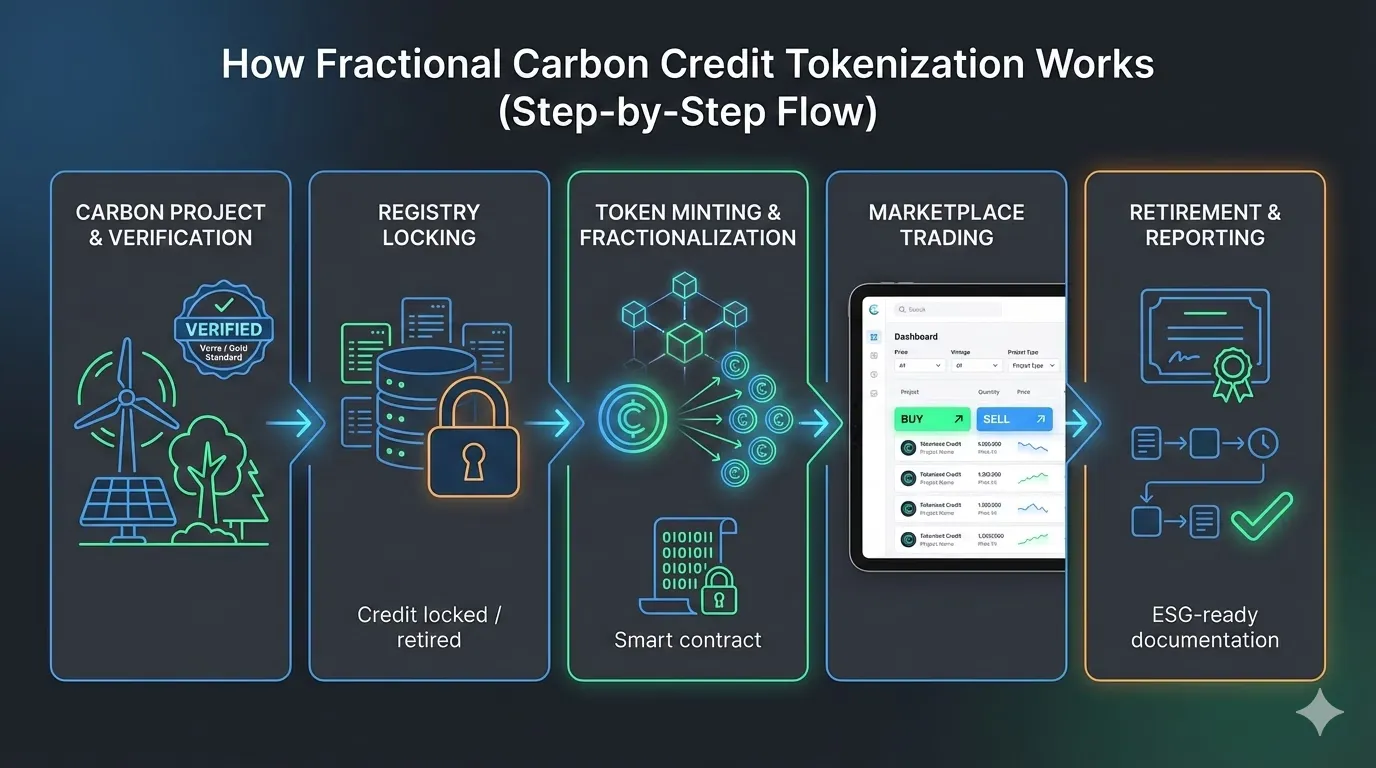
How Fractional Carbon Credit Tokenization Works (Step-by-Step Flow)
- Credit Issuance & VerificationCarbon reduction projects are validated by recognized standards (Verra, Gold Standard, ACR).
- Registry Locking & Token MintingCredits are locked or retired at the registry level and minted as blockchain tokens.
- Fractionalization via Smart ContractsTokens are divided into precise fractional units (e.g., 0.001 tCO₂e).
- Marketplace TradingBuyers discover, purchase, and transfer fractions instantly via an automated platform.
- Retirement & Audit TrailFractional credits are retired with immutable records and downloadable compliance reports.
Case Study: $180K Platform Investment Generating $750K in Annual Revenue
A renewable energy project developer launched a tokenized carbon marketplace in Q2 2024 to address three challenges:
- Limited buyer diversity
- Long enterprise sales cycles
- Unsold credit inventory
Before implementation:
- 23 enterprise clients
- $85,000 average deal size
- 127-day sales cycles
- 34% of credits unsold after 18 months
After fractional tokenization launch:
- Platform live in 14 weeks
- Credits divided into 0.01-ton units
- Automated discovery, checkout, and retirement
Results in 12 months:
- 847 active buyers
- 412 small businesses
- 289 mid-market firms
- 146 enterprises
- Average transaction value: $3,200
- Transaction frequency increased 28×
- Unsold inventory dropped from 34% to 4%
- Revenue grew from $1.95M to $2.71M
One key challenge: registry integration delays slowed initial onboarding. Solution: parallel registry synchronization and phased token minting reduced future onboarding time by 60%.
Total platform cost: $180,000 First-year net revenue uplift: $750,000 ROI: 316% (excluding multi-year recurring revenue)
Technical Architecture for Tokenized Carbon Platforms
Successful platforms rely on four tightly integrated components:
1. Tokenization Engine with Registry Integration
- Connects to Verra, Gold Standard, ACR
- Enforces one-to-one credit-to-token mapping
- Prevents double counting via irreversible registry actions
2. Fractional Ownership Smart Contracts
- Enables arbitrary fractional purchases (e.g., 0.374 units)
- Maintains cryptographic proof of ownership
- Supports transfer and retirement at any fraction size
3. Automated Marketplace & Price Discovery
- Real-time pricing based on:
- Credit type
- Vintage year
- Demand signals
- Self-service onboarding and instant settlement
4. Compliance & Retirement Infrastructure
- Immutable retirement records
- Audit-ready ESG documentation
- Integration with reporting and disclosure systems
Is Fractional Carbon Credit Tokenization Legal and Compliant?
Yes—when implemented correctly.
Fractional tokens do not create new carbon credits. They represent partial ownership of existing, verified credits.
Compliance alignment includes:
- Registry-level retirement or locking of source credits
- Full traceability to project ID and methodology
- Alignment with ICVCM Core Carbon Principles
- Support for evolving digital MRV frameworks
Well-designed platforms operate as technical infrastructure, not issuers of environmental claims—ensuring regulatory compatibility.
Traditional Carbon Trading vs Tokenized Fractional Markets
| Factor | Traditional Markets | Fractional Tokenization |
| Minimum purchase | 1,000+ credits | Any fraction |
| Buyer access | Enterprises only | SMEs + enterprises |
| Liquidity | Low | High |
| Settlement | Manual | Instant |
| Transparency | Limited | On-chain |
Who Should Build a Fractional Carbon Credit Platform?
This model delivers maximum value for:
- Project developers with unsold inventory
- Carbon brokers serving SME demand
- ESG SaaS providers expanding monetization
- Fintechs entering climate markets
If you manage supply, demand, or compliance—owning the infrastructure compounds value.
Revenue Models Platform Operators Often Overlook
Beyond transaction fees:
- Market intelligence subscriptions from anonymized trading data
- Verification & certification services embedded into claims workflows
- API access fees for enterprise procurement integrations
A platform processing $30M annually can generate $1.15M+ from the same infrastructure.
Why Timing Matters: The 24-Month Advantage Window
Early entrants benefit from:
- Network effects that lock in liquidity
- Influence over emerging standards
- Deep integration into ESG workflows
Late movers will pay rent to infrastructure owners—or struggle to compete.
Implementation Roadmap: 90 Days to Market
Weeks 1–4: Architecture & compliance design Weeks 5–10: Smart contracts, marketplace, registry integration Weeks 11–13: Security audits, pilot launch, scale testing
Speed matters. Every month of delay compounds opportunity cost.
Fractional Carbon Credit Tokenization as a Competitive Advantage
The carbon market is consolidating around platform ownership, not participation.
Owning tokenized infrastructure means:
- Capturing transaction economics
- Controlling data visibility
- Defining market standards
This isn’t just about compliance—it’s about who controls climate market infrastructure.
FAQs
**Is fractional carbon credit tokenization legal?**Yes, when credits are locked or retired at the registry level and fully traceable.
**Can fractional credits be retired partially?**Yes. Smart contracts allow retirement of exact fractions.
**Which blockchains are best for carbon markets?**Ethereum, Polygon, and enterprise private chains depending on cost and compliance needs.
**How do platforms prevent greenwashing?**By linking every fraction to a verified source credit with immutable audit trails.
Ready to Calculate Your Platform ROI?
Get a 30-minute feasibility call—no sales pitch, just numbers.
You’ll receive:
- ROI projection based on your market
- Recommended tech stack
- Regulatory readiness score
Contact Techaroha today to assess your fractional carbon credit tokenization opportunity. [Start Your Platform Assessment →]
Written by
Rasika Deshpande
Techaroha Solutions